 Saved Father |
 Saved mother |
Figure 2-1
In the first chapter we considered why God has given us parents. Parents are a BRIDGE which should bring a child or a young person to God. Parents should be PROVIDERS, PROTECTORS, DISCIPLINARIANS, TEACHERS, EXAMPLES and LOVERS to their children. This is their God-given responsibility.
In real life, however, parents often fail to be what they should be to children. Instead of being a BRIDGE to God they sometimes seem like a BLOCKADE. Often PARENTS ARE NOT WHAT THEY SHOULD BE. WHY is this so? Why are there so many problems in the home? How does my own home and family situation affect me? Do I really understand the home and family situations that others are in? If I live in a difficult family situation, what can I do, in the middle of the mess? How can things CHANGE for the better?
In the last chapter we studied the ideal situation--what parents should be:
Saved Father |
Saved mother |
Figure 2-1
Both spiritually healthy and putting God's Word to work in the home!
Sadly, most parents fall short of God's ideal (just as most children fall short of what God wants them to be and to do and to say). As a result of man's failure, there are a great variety of possible situations and conditions that could describe your parents. On the next page some of these situations and conditions are illustrated. DO ANY OF THESE FIT YOU AND YOUR SITUATION?
Saved Father |
Unsaved Mother |
Unsaved Father |
Saved Mother |
Unsaved Father |
Unsaved Mother |
Father |
 No Mother --Death --Divorce --Desertion --Separation --IIlness (prolonged stay in hospital) |
 No Father --Death --Divorce --Desertion --Separation --IIlness (prolonged stay in hospital) |
Mother |
No Father |
No Mother --Death --Illness --Other Reasons
|
Figure 2-2
In the Bible there are many examples of different situations with parents. Did Benjamin ever know his mother (Genesis 35:16-19)? _____________ (She was Joseph's mother as well) When Joseph was only ______ years old (Genesis 37:2) he was carried away from his father into Egypt (Genesis 37:28, 36). Moses, though nursed by his real mother, was adopted by Pharoah's daughter and educated by the Egyptians (Exodus 2). How often did Samuel see his parents (1 Samuel 2:19)? ________________________
Consider Solomon's son Rehoboam. How many wives did his father have (1 Kings 11:3)? _________________________ What does the Bible tell us about Esther's parents (Esther 2:7)? _____________________________ James, the half-brother of Jesus, lost his father (Joseph) by death (this probably happened when James was in his late teens or twenties). We know that Joseph and Mary had at least 6 children (Mark 6:3) but apart from this we hear nothing further about Joseph and we assume he died. John the Baptist's parents were very old (Luke 1:7). Timothy's grandmother and mother were very interested in the Bible (2 Timothy 1:5; 3:15). Did his father have this same interest (Acts 16:1--"Greek" = Gentile)? ______
None of these were ideal situations, but they all worked out according to God's purpose and for God's glory!
Concerning the spiritual health and life of the parents, there are numerous possibilities. The Father or Mother could be described according to their spiritual state as follows:
All kinds of combinations are possible from the descriptions found on page 7. For example, a Father could be C, F, K, O, S, W, Y and a Mother could be A, E, I, M, Q, V, X. Before you think about which letters best describe your parents, you should ask, "WHICH LETTERS BEST DESCRIBE ME?" ("JUDGE ________ O GOD"--Psalm 43:1; 26:1; that’s always a good place to start!).
Consider your friends in school and in Sunday School. Will the various situations and conditions of their parents be the same as yours? Is every family situation unique and different from others?
There are other common problems in the home where PARENTS ARE NOT what they should be:
What is the reason for all of these problems in the home? In Matthew 19:3-9, the Lord discusses one serious problem (DIVORCE) but He helps us to understand the reason for all of these problems we have been thinking about. The KEY VERSE is verse 8. Was DIVORCE God's original purpose and desire for the home? __________ DIVORCE, and all these other problems have come about "BECAUSE OF THE ________________ (v.8) OF YOUR (MAN'S) _____________." Yes, it is the sinfulness of man that is the cause of the multiple problems that we find in the homes. How did Jesus describe even the best of fathers (Matthew 7:9-1l, especially verse 11)? __________ How would you describe your parent’s hearts (Jeremiah 17:9)? ______________________________________________________ How would you describe your own heart? ______________________________________________________
There are other differences between families that must be recognized. Not all parents are the same. They differ in MANY ways. Here are just a few example:
Very often a young person finds himself (or herself) in a difficult family situation (problems with parents, etc.). He (or she) may look at another family and this family may seem to enjoy a much better relationship between children and parents, brothers and sisters, etc. As a result, it is possible for a young person to become JEALOUS or ENVIOUS, even to the point of BITTERNESS and HATRED:
"I see your home and now I hate mine!"
"I wish I had the kind of family life you have."
"My parents don't do things or go places like his/her parents."
"His home always seems like heaven; mine always seems like hell."
The above statements are all a result of wrong thinking and a failure to handle the situation in the right way.
Which of the following had a real problem with jealousy and envy in their family relationships (circle the 3 correct answers):
Another possible problem is that a person who enjoys a good family situation may look down on and despise those who are having real problems and battles in the home, without really understanding what this person faces every day. It is of utmost importance that young people realize and understand that there are very real differences and variations with parents and situations and circumstances and backgrounds. You must KNOW the differences and MAKE ROOM FOR the differences (be gracious and understanding) and ALLOW FOR such differences in dealing with your friends, schoolmates and companions at church.
There is a difference between a HOUSE and a HOME. A HOUSE is a building where people live (AN ADDRESS). A HOME is where a FAMILY lives and relates and converses and functions in a wonderful and blessed TOGETHERNESS:
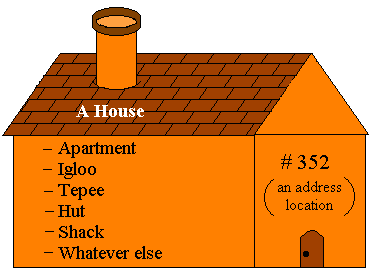
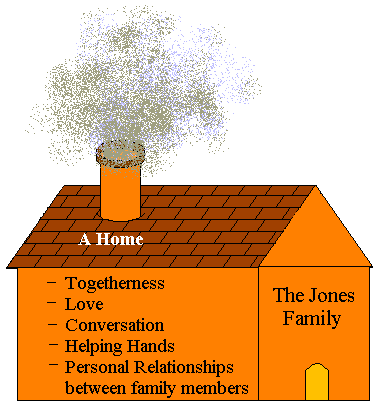
We say "HOME SWEET HOME" but we would never say "HOUSE SWEET HOUSE"! We might say, "There is no place like HOME" but we would never say, "There is no place like HOUSE!" Is there a difference between a house-keeper and a home-maker? Anyone can live in a house! It takes some work to make a house become a home. Are you doing your part?
It is important to realize that MY HOME IS NOT HEAVEN. I may have a wonderful home where Christ is acknowledged as the Head, where the family members seek to honor and obey the Bible where God is feared and where Christian love prevails, BUT IT IS STILL NOT HEAVEN (and in fact, even this is very rare!).
What is true about each member of the family (Romans 7:18,24)? __________________________________________________________________ Is the devil alive and actively seeking to destroy and disrupt the family unit which is ordained by God (1 Peter 5:8)? _______________ Does the world exert a great influence upon even the strongest families (Romans 12:2; 1 John 2:15-17)? _______ In heaven do you think there will be 1) people with evil hearts; 2) a destroying devil; and 3) an alluring world system to attract and charm? _______ Is your family problem-free? __________ Have you ever known of a family that was free from problems? __________ Christ should fill the heart and the home more and more, and the more He does the more heaven-like the home will become, but the home will never be heaven. The home belongs to time; heaven belongs to eternity.
It is also important to understand that MY HOME IS NOT HELL. I may have the most terrible home life imaginable, but it is not hell. My family members may speak of hell frequently as part of their vocabulary but this does not make it hell.
Family life might be miserable, but the miseries of this life are not worthy to be compared with the eternal suffering and punishment of hell. Your home is not the lake of fire and it is not a place prepared for the devil and his angels and it is not the second death and it is not a place where God's wrath and judgment is upon you. Don't ever say, "Nothing could be worse than my home situation." No, there is a very real hell that is much worse! Your home belongs to time; hell belongs to eternity.
IF YOU HAVE NOT YET ENTERED ETERNITY, THEN YOU ARE NOT YET IN HEAVEN AND YOU ARE NOT YET IN HELL!
How can things CHANGE for the better? God's secret for change is this: Don't look for your family situation to change. Don't look for your family members to change (if they do, thank God for it, but don't look for that to happen). Don't look for your environment (the things around you and the place you live in) to change. Don't look for your problems and your difficulties to change. The SECRET is this: YOU CAN CHANGE!!! You can change by the transforming grace of God! God is sufficient for every situation!
God can help you to be (and make you to be) a testimony in the middle of the mess! If you get your heart right with the Lord and begin to obey His Word, God can change you and cause HIS BLESSINGS to pursue you and overtake you and run you down (see Deuteronomy 28:1-2)! Give your ashes to God and watch what He will do (Isaiah 61:3)!
The CHANGE must take place in you! Things will not change for the better but YOU will change for the better (and that will make everything else seem better!). Everything else may stay the same, but YOU WILL BE DIFFERENT! And a different you will make all the difference in the world!
Is God able to change and continue to change a life?
Do you believe God can change you?
Will you let Him begin right now?
Back to RELATIONSHIPS
Back to SUNDAY SCHOOL MATERIALS & HELPFUL BIBLE
STUDIES