For another helpful presentation on the Pilgrims check out the
following link:
Why We Celebrate
Thanksgiving -- Those Remarkable Pilgrims
The brave Pilgrims sought to shine in a dark world. Their devotion to
God and their arrival in America was a great event which changed the world.
The leaders of the Reformation tried to go back to the Bible. In many ways, however, they did not go back far enough. They left the false religious system, but when they left, they took part of the system with them. This situation can be compared to a person who has cancer. The doctors operate and remove the deadly cancer. Sometimes, however, they are not able to get it all, and even though most of the cancer is gone, the body is still contaminated with the terrible disease and the person’s condition will eventually get worse and worse! The Reformation churches had gotten rid of much of the error of the false religious system, but not all of it. They were still contaminated! Today, many Protestant churches (churches who can trace their beginnings back to the Protestant Reformation, such as Lutheran churches, Presbyterian churches, Methodist churches, Episcopalian churches, etc.) do not preach and teach the Bible (see 2 Timothy 4:3-4) and do not believe that the Bible is the Word of God (2 Tim. 3:16)..
The Roman Catholic Church can be considered the "mother church" because all the churches of the Reformation came out of her. A baby begins inside his mother (he is a part of her) and then is born, but he is still connected to his mother by the umbilical cord (that cord which brings nourishment from the mother to the baby and which was once connected to the mother's belly button or navel). Complete separation only occurs when the umbilical cord is cut! The churches of the Reformation came out of the Roman Catholic Church but the umbilical cord was never cut. Since then the mother church has been slowly drawing the babies back to herself! Complete and total separation never really took place.
The Church of England (called the Anglican Church or the Episcopal Church) was one of the Reformation babies. In many ways this church resembled its mother (the Roman Catholic Church). It was contaminated with a terrible cancer. The Church of England was controlled by the government (led by the King or Queen), and the government told the people how they should worship. Who should tell the believer how to worship? (circle the correct answer):
|
a. |
the Pope |
b. |
the Pastor |
|
c. |
the President |
d. |
the people (the believers) |
|
e. |
God, as revealed in His Word |
||
The Church of England was not what God wanted a church to be. It was not like the churches we read about in the New Testament. The Church of England was too much like its mother!
There was one group of people in the Church of England who were called Puritans. Many of these were probably true believers. They knew that the Church of England was not everything it should be and it was not everything God wanted it to be. The Puritans wanted to reform and change the church by staying in it. They hoped they could purify the church. The Puritans wanted a right church and a right government which would compel all men to walk in the right way. They saw the terrible cancer that was still in the church, but they thought they could somehow make the cancer good. This is like teaching a pig to stay out of the mud!
Another group of people in England were known as the Separatists. These people loved the Lord and knew their Bibles very well. They believed in complete separation from the Church of England. They knew that cancer is cancer, and the umbilical cord must be cut! They understood that being connected to a false religious system was not helpful. They only wanted to be connected to the Lord and to His Word. They wanted freedom of religion. They did not want the government to tell them how to worship; they wanted to be able to govern themselves. They wanted the freedom to worship in the way the Bible commands. They wanted liberty to worship God according to the dictates of their own conscience (as they knew they must). They believed Christ was the Head of the Church, not the English government. Were they right (Ephesians 1:22; Colossians 1:18)? _________ Is separation sometimes needful and necessary (2 Corinthians 6:14-7:2; Timothy 3:5; Revelation 18:4)? ________
The Separatist "wanted liberty for himself and his wife and little ones, and for his brethren, to walk with God in a Christian life as the rules and motives of such a life were revealed to him from God’s Word" (from Leonard Bacon’s Genesis of the New England Churches –1874). The separatists strongly believed that every congregation of believers should be a separate body and not subject to a central authority or a central government of any kind. They believed that each local church or congregation is a complete church in itself and that no church should have anything to say about any other church. Christ should tell the church what to do, not some other church. They believed the same thing the Middletown Bible Church believes, that all local churches should be independent of each other. We should be completely independent but completely dependent upon Christ (John 15:5)!
One group of Separatists left England and eventually came to New England. These people are today known as the Pilgrims. Most of what we know about the Pilgrims is based upon the writings of William Bradford, a godly believer who for more then 30 years was the beloved governor of the small Pilgrim Colony in New England. At the age of 12 Bradford became a constant reader of the Bible, and His love for the Scriptures is seen throughout his writings. Bradford was one of the believers who came over on the Mayflower. He wrote this about the courageous Separatists: "So they left that goodly and pleasant city which had been their resting place near twelve years (this was when they left Holland and just before they departed for America); but they knew they were pilgrims, and looked not much on those things, but lift their eyes to the heavens, their dearest country, and quieted their spirits" (Of Plymouth Plantation, by William Bradford, edited by Samuel Eliot Morison, published by the Modern Library, New York, 1952, p. 47). Because Bradford wrote these words, the small group of Mayflower separatists became known as the Pilgrims. A pilgrim is a person who is traveling in a foreign land, a land that is not his home. Are you a pilgrim (Hebrews 11:13-16; 1 Peter 2:11; Genesis 47:9)? ________ If you are a saved person, where is your true home (John 14:2-3; Philippians 3:20)? ______________________________________________ Is this world the believer’s home (John 15:19; 17:14,16)?_______
When the Pilgrims lived in England they were not given freedom to worship as they desired. The English government persecuted any group who separated themselves from the Church of England. Private religious meetings were not allowed. The government only approved of one church – the Church of England. King James I (the king who is best known for the great Bible translation project which he sponsored) ordered complete and unreserved acceptance of the Anglican Church (the Church of England). In other words, if you did not go along with the "approved" church, you would get in trouble. The government would punish and persecute those who did not worship as the government thought they should.
Thus the Pilgrim Separatists were hunted and persecuted. Some were imprisoned and others were forced to flee. What does the Bible say about those who will live godly in Christ Jesus (2 Timothy 3:12)? ________________________________________________________
Finally the Pilgrims moved to Holland where there was religious freedom, but there they faced other great problems. Imagine going into a strange land where you must learn a new language and try to earn a living by doing difficult work which you were not accustomed to. Also Holland was continually threatened by war. The Pilgrims found that their children were being tempted by the things of the world and being corrupted by evil examples all around them.
After spending 12 years in Holland, the Pilgrims decided to migrate to America. They wanted to rear their children in the faith of their fathers, and at the same time, to teach them English ways and language rather than Dutch. Also, according to Bradford, they had "a great hope of laying some good foundation for the propagating and advancing the gospel of the kingdom of Christ in those remote parts of the world; yea, though they should be but even as stepping-stones unto others for the performing of so great a work" (Of Plymouth Plantation, page 25). In other words, the Pilgrims were very missionary minded and they wanted to proclaim the good news of Christ to the uttermost parts of the earth (Mark 16:15; Acts 1:8).
The Pilgrims were able to find a trading company to finance their voyage and they sailed off to the New World on the Mayflower with 102 passengers. One of the sailors, an unsaved man, gloated at the Christians because they became seasick. He boasted that he would soon sew them all in shrouds (burial garments) and feed them to the fish. Ironically, this very crewman came down suddenly with a strange fever and died within a few hours. No one else contracted this "mysterious" disease, and his was the first shrouded body to go overboard. The mocking ceased. [Peter Marshall and David Manuel, The Light and the Glory, page 117 and David O. Beale, "The Pilgrims and God's Providence," Faith for the Family, November 1984, p. 5.]
Another account of this is as follows:
A proud and very profane young seaman, the bitterest against them of all the wild crew, had mockingly said he hoped to help cast half of them overboard before they reached land. Soon after, he was smitten with a grievous malady and shortly died. As they solemnly consigned his body to the sea, both passengers and crew stood awed, believing that this was none other than the just hand of God upon his wickedness. [James Daugherty, The Landing of the Pilgrims, in the famous Landmark Books series, Random House, 1950, page 43]
"One passenger nearly paid with his life for disobeying the order to remain below deck during the storms. During one prolonged storm, John Carver's servant, John Howland, could no longer endure the stench of the crowded living quarters. Climbing out onto the sea-swept main deck, Howland lost his balance and fell into the huge, boiling waves of the Atlantic. Providentially, the vessel was rolling over so far that the lines from her spars were trailing in the water. As one of these snaked across Howland's wrist, he instinctively grabbed it and hung on. Rescued from the jaws of death, Howland never again raised his head above deck without an invitation" [Peter Marshall and David Manuel, The Light and the Glory, pages 117-118 and David O. Beale, "The Pilgrims and God's Providence," Faith for the Family, November 1984, p. 5.]
Another historian describes this same remarkable rescue:
As the weather worsened, Master Jones [the ship's captain] ordered that in heavy seas all passengers must remain below decks. In spite of orders, young John Howland ventured out on the main deck in the midst of a violent gale. A great wave struck the ship and pitched him into the raging sea.
"Man overboard!" The shout was lost in the roar of the storm as the yellow head of John Howland disappeared in the furious waters. And then the incredible happened. As Howland went down, his hand grasped the end of a rope that trailed over the ship's side. When the ship rose on the next wave, Howland, clinging desperately, was swung against the ship's side. In a moment a boat hook had been thrust through his leather jacket, and he was hauled over the rail to safety. It was the hand of God that reached out and saved him, said every Pilgrim on the "Mayflower." [James Daugherty, The Landing of the Pilgrims, in the famous Landmark Books series, Random House, 1950, pages 43-44]
Three Presidents (Franklin D. Roosevelt, George H. W. Bush, George W. Bush) came from the direct line of John Howland as well as a great number of other famous people. History would have been very different if Howland had drowned on that day. For more information on this, and to learn who some of his descendants were, see The Remarkable Story of John Howland and The Descendants of John Howland.
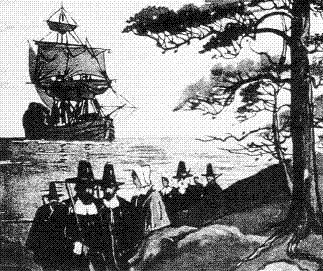
The voyage took 65 days and they met with many fierce storms, but God brought them safely to Cape Cod. They arrived in November of 1620.
Can you imagine arriving off the shores of Massachusetts, just as winter was beginning, without houses or shelter (except for the ship that brought you)? The first winter for the Pilgrims was extremely difficult, especially the cold months of January and February. Forty-seven people died, almost half the number of those who had come to the new land. With the coming of the spring, conditions improved greatly and the sick began to recover.
The first harvest was small with the corn doing well, but the barley only fair, and the peas not worth gathering. The Pilgrims gave thanks to a great God nevertheless. Americans remember their unfailing trust in God, their thankful spirit and their perseverance amidst great difficulties. Each November we celebrate Thanksgiving, to remind us that we too should be thankful as the Pilgrims were.
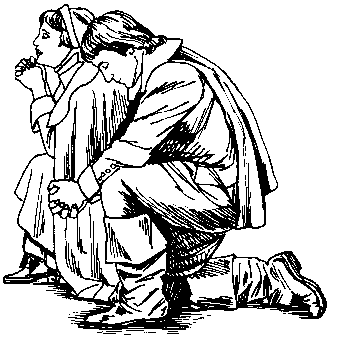
We should remember the unsinkable faith of these determined Christians. They had a small harvest, not a large one, and thought themselves fortunate. They buried more than half of their number and thanked the Lord for those who recovered. They were handicapped and hobbled in many ways by the London investors, but they never gave up. They trusted the Lord; they thanked Him; they persevered. For ancestors like these, we should give thanks every month of the year. [Sally Humphries, "A Feast of Faith," Faith For the Family, November 1977, p. 8.]
In the winter of 1621-1622 food was again very scarce. Another ship, the Fortune, had landed, dropping off 35 more colonists, but these new people had no food with them. With all these extra people to feed, the daily ration of food was reduced to five kernels of corn for each person! What if your mother gave you five kernels of corn for supper and nothing else! Would that fill you up? God sustained these people and not one of them died of starvation. In 1623 the harvest was abundant and a second Day of Thanksgiving was planned. More than 120 Indians joined the pilgrims. Their feast consisted of venison, grapes, plums, nuts, six goats, fifty hogs and pigs and hens. Before any of this food was served, the first course was given to every person. On an empty plate in front of each person were five kernels of corn. They did not want anyone to forget! [Peter Marshall and David Manuel, The Light and the Glory, pages 136, 137, 139, 144.]
We have received much more than a national holiday from the Pilgrims. Their influence goes far beyond that. These were a people who were greatly concerned "for the Glory of God and advancement of the Christian Faith" (these words are written in the Mayflower Compact). These people wanted to have a church that was free from all cancer, where the umbilical cord was completely cut! They wanted to go back to being a New Testament kind of church. As Bradford has written at the very beginning of his history: Satan does not want the churches of God to "revert (go back, return) to their ancient purity and recover their primitive order, liberty and beauty" (Of Plymouth Plantation, p. 3). The Pilgrims wanted the Bible to be their only authority and guide.
These Pilgrims joined themselves together, seeking to form a church according to the Scriptures, "in the fellowship of the gospel, to walk in all His ways made known, or to be made known unto them, according to their best endeavours, whatsoever it should cost them, the Lord assisting them" (Of Plymouth Plantation, p. 9). It did cost them something but they were willing to pay the price!
Somehow the Pilgrims knew that what they were doing was important! The world was watching them and they seemed to know it! The world was going to see what would happen to a small group of people who really tried to let God be God, and who put their trust in Him. As Bradford states in his history, "God, it seems, would have all men to behold and observe such mercies and works of His providence as these are towards His people, that they in like cases might be encouraged to depend upon God in their trials, and also to bless His name when they see His goodness towards others…God in such examples would have the world see and behold that He can do it (that is, that He can be God and provide for His own) without them; and if the world will shut their eyes and take no notice thereof, yet He would have His people to see and consider it" (Of Plymouth Plantation, p. 329).
Yes, the Pilgrims sailed forth to be a candle that would be a light to many. Ten years after the Pilgrims landed in New England, William Bradford wrote these memorable words:
Thus out of small beginnings greater things have been produced by His hand that made all things of nothing, and gives being to all things that are; and, as one small candle may light a thousand, so the light here kindled hath shone unto many, yea in some sort to our whole nation; let the glorious name of Jehovah have all the praise! (Of Plymouth Plantation, p. 236)
In the middle of a dark and evil world, the Pilgrims were seeking to shine!
Soon after the Pilgrims came to America, large numbers of Puritans began to migrate to the Massachusetts area from England. They were not as Biblically solid as the Pilgrims. Soon the church was contaminated again with that which was less than God's best, and the Pilgrim candle was dimmed--dimmed, but we trust, not extinguished and not forgotten!
* * * * * * * *
|
Roger W. Babson, the famous financier and statistician, tells of a visit he made some years ago to the president of the Argentine republic. He says:
Babson made this concluding observation: "Let us as Americans never kick down the ladder by which we climbed up. May we never forget the foundation upon which our permanent prosperity is based." (This is taken from OUR DAILY BREAD, May 24, 1964, Radio Bible Class) |
Back to GREAT EVENTS
Back to SUNDAY SCHOOL MATERIALS & HELPFUL BIBLE STUDIES
Home Page