2 Chronicles 20:1-30

King Jehoshaphat and the kingdom of Judah were about to be invaded by their enemies,
and thus they faced a national crisis. This crisis was unique to Jehoshaphat and to the
people of his day. Tomorrow you do not have to worry about being invaded
by the
Moabites! Yet, the way in which Jehoshaphat handled the crisis suggests to us certain principles
which, if properly applied, can be used in conquering the crises and solving the problems
that we face in our daily walk with the Lord.
The living God has the solution to our problem. Christ is greater than any crisis!
Therefore, before we do anything else, we must turn to Him. The King (v. 3) and the people
(v. 4) decided to seek the Lord’s solution.
As the King prayed, he said, "Art not thou __________ in _________________? (He’s the
Sovereign Lord) and _____________________ not thou over all the kingdoms of the heathen? (He’s the
Supreme Ruler), and in thine hand is there not ________________ and ___________________, so that
none is able to withstand thee? (He’s the Almighty God)"
The God who drove out the Canaanites (in the days of Joshua) was certainly able to keep
out the Moabites and Ammonites (in the days of Jehoshaphat). The God who gave them the land
could certainly help them to keep the land. Likewise, is the God who saved you
from eternal condemnation (your greatest problem) also able to deliver you from the lesser
problems that you might face? ______ If He took care of your eternal needs, can He also
very easily take care of your temporal, day by day needs? _______
God promised that if His people should cry out to Him in their time of great distress,
He would H______________ and H_____________ (verse 9–the word ‘help’ means
God would save and deliver and rescue them from the crisis). God will do the same today!
Instead of holding on to the problem and worrying about it, what should we do according
to 1 Peter 5:7 and Philippians 4:6? __________________________________________________________________________________________
Did King Jehoshaphat do this? ________
Jehoshaphat said, "We have no M _____________" (verse 12). Who did have
might
(see verse 6)? _________________ When is a believer strong (2 Corinthians 12:9-10)? __________________________________________________
The King also said, "neither known we ______________ to ______" (verse 12). "I
don’t know the solution but I know Someone who does!" If a believer lacks wisdom
in the middle of a great trial or crisis, what should he do (James 1:2-7)?
_____________________________________________________________________________________
Even though the King confessed that he and his people had no might and no wisdom, he confidently said, "but our __________ are upon Thee" (verse 12). When our eyes are fixed upon the Lord, the problem becomes very insignificant. The danger comes when we become so engrossed with the problem that we forget the Lord and we forget His promises. Who is one person in the New Testament who took his eyes off the Lord (Matthew 14:25-33)? _______________

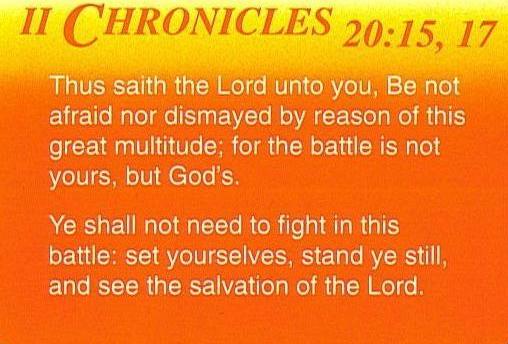
In this remarkable battle, Who promised to do the fighting? ___________ (verses 15 and 17). Did God say that the people would fight the enemy or that the people would find the enemy (verse 16)? _____________________________ Is there a difference? _________ The battle belongs to God and not to us. God’s responsibility is to solve the problem. Our responsibility is simply to trust Him. God never asked us to solve our problems in our own strength or in our own wisdom. God has the solution and there is no problem too big for God.
The King and the people bowed down before God in humble adoration and worship. In our
particular problem or crisis, we must do the same. We must humbly recognize our weakness
and claim God’s strength (2 Cor. 12:9-10; Eph. 6:10; 2 Tim. 2:1). We must humbly
acknowledge our insufficiency ("I do not have the adequate resources to
handle this problem or crisis") and realize the sufficiency of God (God does
have the resources to handle and solve this problem–2 Cor. 12:9; John 15:5;
Philippians 4:13).
These Jews praised the Lord with an exceedingly loud voice. Each one put his whole heart
into it! So too, we need to enthusiastically tell God how great He is (Psalm 34:1-3).
The people rose up ________________ in the morning and went out according to God’s command (verse 20). They wasted no time in obeying God! The believer does not need to run away from the crisis (as we discussed in chapter 12). With full confidence in the LORD the believer can meet the problem head on. Did Daniel run away from the lions?________ (He faced them and God took care of them!) The world does everything possible to avoid and escape their problems. The believer who has God as his Helper (Heb. 13:5-6) can enter the heat of the battlefield with full assurance of faith (compare Romans 8:31)!
|
Note: Even though the "battle is the LORD’s" we are not to be
passive as God solves the problem. There are some things that we are able to do
and that God expects us to do. David did his part with his sling and his stones. God did
His part with the giant (Goliath). In Acts 12:1-9 Peter had a problem. He was in jail and could not
break his chains. That was something only the Lord could do. There was something, however,
that Peter was able to do and which the Lord expected him to do. What was it? |
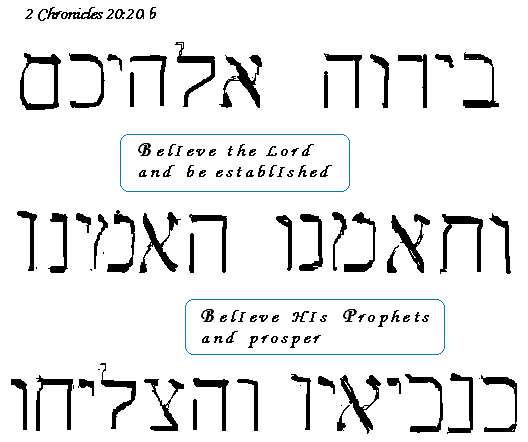
Faith is taking God at His Word. Faith is believing that God is able to keep His promises. "B________________ in the LORD your God, so shall ye be ____________________________" (verse 20). In other words, if you put yourself in His hands, He’ll hold you up! If you come under His wings, He’ll shelter and protect you! If you stand on the Rock, then you will be established on the Rock (Psalm 40:2)! God has spoken and said, "The battle is the LORD's!" Are we going to believe that word? Are we going to claim that promise by faith? "B_____________________ His prophets, so shall ye P___________________" (have success–verse 20).
The expression "Praise the LORD" can be translated "Give thanks to the
Lord." Philippians 4:6 tells us to pray and give our problems to the Lord
"with __________________________." Notice that the people gave thanks to God
in the middle of the crisis, even before it was over. Later when the crisis was all over, they gave thanks
again (see verses 26-28). We need to learn to give thanks in the middle of the problem and
in the middle of the battle, and then again once God has conquered the crisis!
When did God begin to do His great work? "When they began to _____________ and
to _____________________" (verse 22). What did the Apostle Paul do in the middle of a prison cell (Acts
16:23-26)? ______________________________________
|
In 2 Chronicles 20:1 we are told that the invasion took place "after this," referring to the previous chapter. In chapter 19 King Jehoshaphat was strongly rebuked by the prophet Jehu because of his compromising alliance with wicked king Ahab. This rebuke proved effective as Jehoshaphat brought the people back to the Lord (verse 4). He also encouraged judges and priests to serve faithfully "in the fear of the LORD" (verses 7,9). Thus the King was seeking the LORD before the crisis ever came. Often we do not seek the Lord until the crisis or problem comes. We turn to God when we are in trouble! Jehoshaphat turned to God before the trouble came and when it did come, he was prepared! |
God is faithful! He cannot fail! He never loses a battle! The people of Judah simply
found the enemy (dead!); they did not have to fight them! They
worked much harder gathering the spoil then they did in winning the battle (see
verse 25).
The people blessed and thanked the Lord for the victory. The result was much joy and peace in the land and God’s name was glorified! If we handle our problems and crises in the right way (Philippians 4:6), then what does God promise as a result (Philippians 4:7)? _________________________________________________________
* * * * * *
This concludes this set of notes on some of the crises of our day and how to handle them. May Christ be the solution to every crisis you face, as you seek Him and turn to His Word!
Back to CRISES OF OUR DAY
Back to SUNDAY SCHOOL MATERIALS &
HELPFUL BIBLE STUDIES
Home Page